
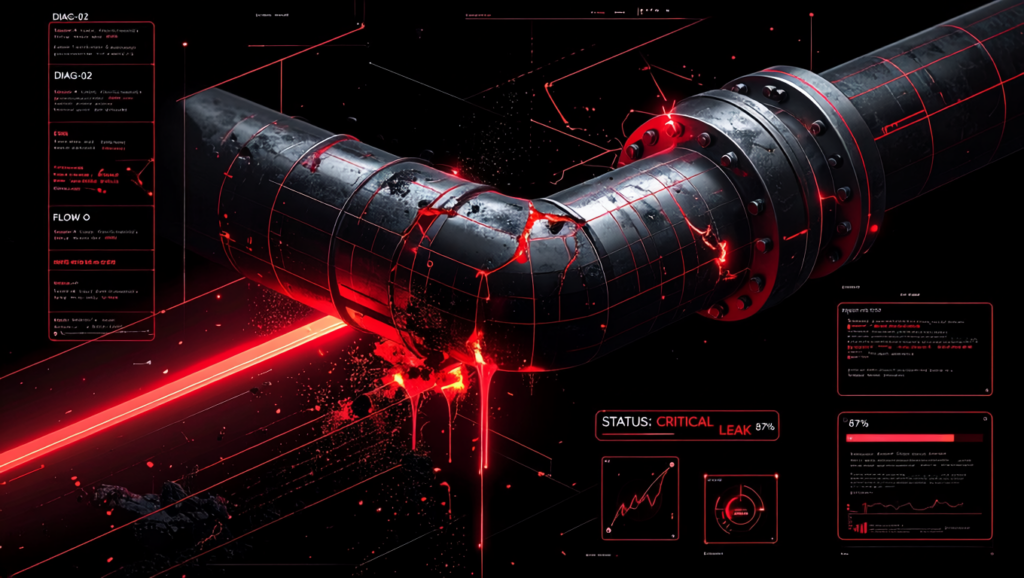
Most business owners operate under a dangerous and expensive illusion: that driving more traffic is the universal cure for a sluggish business.
When your customer acquisition costs spike or your monthly lead volume stagnates, the typical agency recommendation is entirely predictable. They tell you to increase your ad spend, launch new campaigns, and push more raw visitor volume onto your digital property.
That advice is not just wrong. It is an active financial liability.
If your underlying website has even minor technical friction, like slow mobile loading speeds, broken checkout buttons, or untracked contact forms, you are carrying a silent revenue leak. Bolting a larger marketing engine onto a leaking pipeline does not make you grow. It merely accelerates how fast your capital evaporates into thin air.
1. The Real Cost of Uncontrolled Friction
To understand why scaling a broken website is a losing game, you have to look at the mechanics of how a customer actually moves from a click to a paid invoice.
If your conversion path is unoptimized and leaking data signals, increasing your ad spend does nothing to help your bottom line. No matter how aggressively you scale your budget, your revenue stays flat while your monthly ad bills climb.
Scaling a broken digital asset is not growth. It is an expensive drainage event.
2. The Three Hidden Leaks in Your Pipeline
When we audit an operating business, the silent erosion of profit almost always hides inside three core infrastructure gaps:
- Mobile Speed Lag: If your mobile pages take more than a couple of seconds to load, a massive percentage of your visitors will bounce before they ever see your offer. Your ad budget was spent and the click was registered, but the user left because the server took too long to paint the screen.
- Checkout and Form Resistance: Clunky payment pages, confusing form fields, and missing trust signals create immediate buyer friction. High-value clients do not stick around to troubleshoot a broken form. They simply close the tab and call your competitor.
- Tracking Blind Spots: Broken pixel setups and unlinked analytics dashboards prevent your systems from seeing which campaigns actually generate revenue. You end up flying blind, guessing at what works while spending real money.
3. Fixing the Foundation Before You Scale
We do not run generic ad campaigns or sell empty growth hacks. We are infrastructure engineers.
Before you authorize another dollar of ad spend, you need to pull your digital presence into dry dock and lock down your foundation:
- Audit the Speed: Optimize your code and server responses so mobile visitors load your pages instantly without lag.
- Harden the Conversion Paths: Clean up your intake forms, test every checkout button, and remove every ounce of friction between a visitor and your inbox.
- Secure the Tracking: Ensure your conversion events report accurate data so you always know where your money is going.
Seal the hull first. Scale the engine second.
[DOCUMENT_CLOSED]